

How is This Good?!
As a child, I remember thinking it odd that we called the day of Jesus’ death “Good Friday”. I had a vague understanding that Jesus’ death was necessary for our salvation, but I couldn’t grasp why we would refer to the crucifixion of an innocent man (who happened to be God’s Son) as “good”. Of course, as I got older, I realized this amazing sacrifice for us was not only necessary for my salvation but also demonstrated God’s love, mercy, and grace. And while Jesus’s crucifixion is heartbreaking, it is also very, very good.
Good Friday in Sunday School
If you teach a Sunday School class, you will definitely want to teach students about the death of Jesus. How you approach it may depend on the age of your students, but the fact that Jesus endured great suffering shouldn’t be glossed over.
Younger students may not be ready to hear every detail of Jesus’ death but upper elementary students are likely ready to read what the Bible says about the events leading to Jesus’ death. Students should understand that Jesus suffered greatly for us. This ultimate act of love placed the punishment we deserve as sinful people and put it on Jesus (Romans 5:8).
When to Teach a Good Friday Lesson
With the observance of Jesus’ death being on a Friday, it can be tricky knowing when to present this lesson in a Sunday School classroom since you may be covering Palm Sunday the Sunday before and Easter the Sunday after. If you only see your students on Sundays, one solution is to split it between the two weeks. You can introduce your Good Friday lesson after your Palm Sunday lesson and finish it the next week before your Easter lesson on the resurrection. This lesson walks students through the story of Jesus’ death told in Matthew 26:20-60.
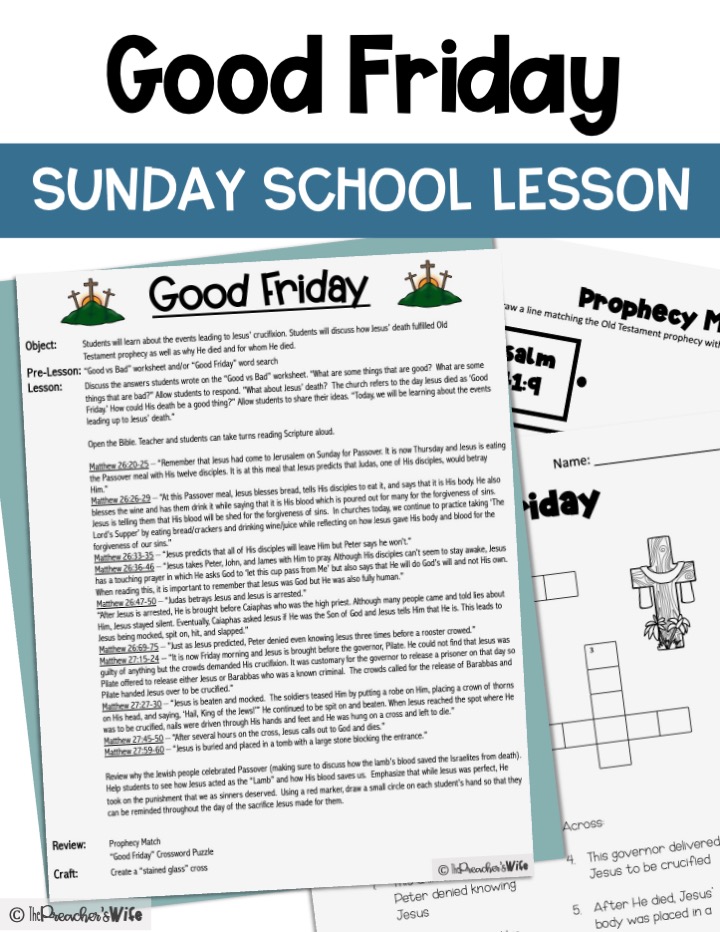
While this lesson uses scripture references from the book of Matthew, all four gospel authors write about the crucifixion (Mark 14-15, Luke 22-23, and John 18-19).
Good Friday in the Old Testament
To help students understand how the entire Bible tells one story, you can show students how the authors of the Old Testament told about Jesus’ death hundreds of years before it happened.
Seeing how Old Testament verses such as Psalm 22:17-18 (All my bones are on display; people stare and gloat over me. They divide my clothes among them and cast lots for my garment.) parallel New Testament verses like John 19:23-24 (When the soldiers crucified Jesus, they took His clothes, dividing them into four shares, one for each of them, with the undergarment remaining. This garment was seamless, woven in one piece from top to bottom. ‘Let’s not tear it,’ they said to one another. ‘Let’s decide by lot who will get it.’ This happened that the scripture might be fulfilled.)
This prophecy matching activity is a great way to do just that. It has two versions included – one only gives the scripture references and requires students to look up each verse on their own and the other has the verses written out.

Good Friday and the Lord’s Supper
Before Jesus was arrested and crucified, He shared a Passover meal with His disciples. During the meal, Jesus identified Himself as the fulfillment of the Passover sacrifice by proclaiming the bread and wine to represent His body and blood which would be given for the forgiveness of sins (Matthew 26:26-28).
This was the first Lord’s Supper. Paul tells us in 1 Corinthians 11:26 that we proclaim Jesus’ death when we partake in the Lord’s Supper. So learning about Good Friday can and should happen more than once a year.
Music About Good Friday
Music can be a great tool in the classroom. Whether it’s played when students are arriving and leaving or played in the background while students work, song lyrics can reinforce a lesson and provide a calm atmosphere. This website has 100 song suggestions that mention the cross.
Sunday is Coming!
When teaching about Jesus’ death on a cross, make sure to remind students that this isn’t the end of the story. Jesus didn’t remain in the tomb and we get to celebrate His resurrection three days after His death! Now THAT is good!!

 The Preacher’s Wife
Leave a comment